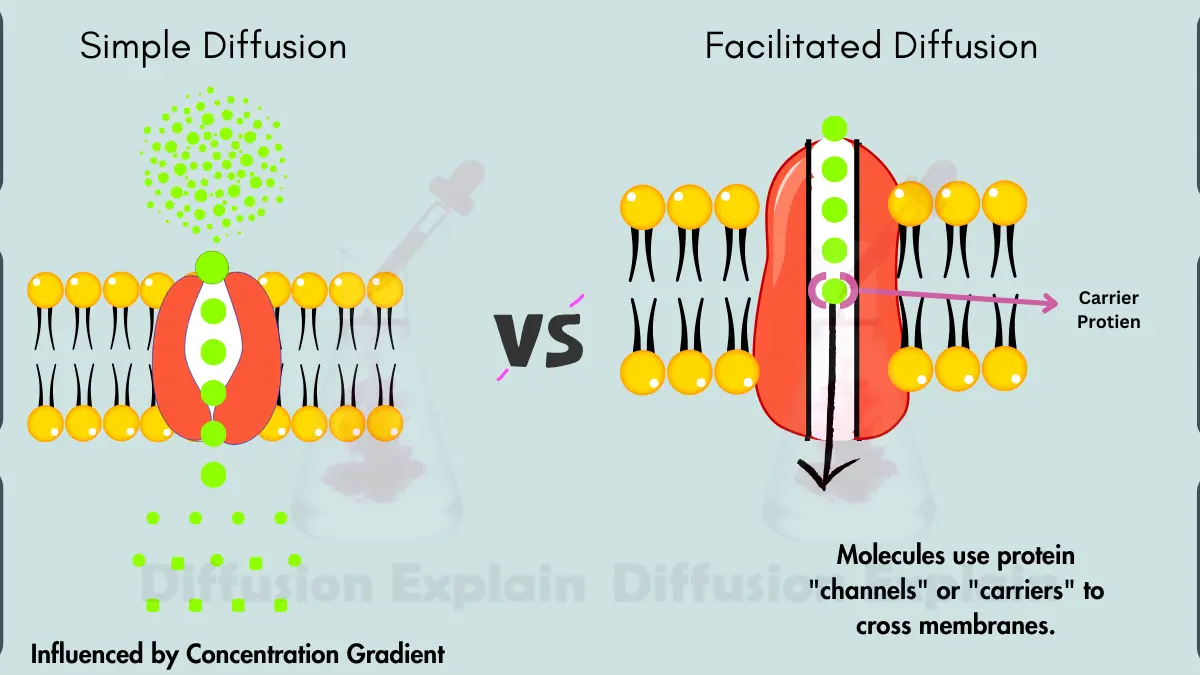
The key difference between simple diffusion and facilitated diffusion is the difference of transport proteins.
In simple diffusion, molecules passively move down their concentration gradient directly through the plasma membrane without any help. While in facilitated diffusion, the transport of molecules occurs by the use of integral membrane proteins that form selective channels or carriers.
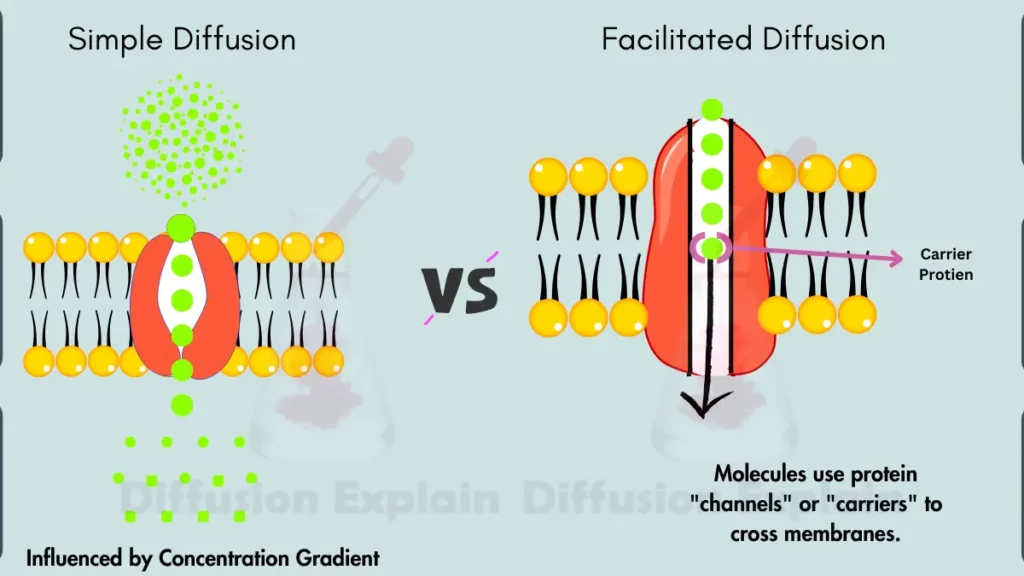
Although both processes are passive along an existing concentration gradient, facilitated diffusion involves proteins that lower activation energy and rapidly transport molecules that otherwise could not effectively cross the membrane.
What is the difference between simple diffusion and facilitated diffusion?
Facilitated diffusion moves larger or polar molecules through the membrane with the help of transport proteins because these molecules cannot pass through the lipid layer by themselves.
Both move down the concentration gradient, but the pathway and types of molecules differ.
Explain one way in which facilitated diffusion is the same as simple diffusion and one way in which it is different.
Different: Simple diffusion does not use proteins, while facilitated diffusion requires transport proteins.
How are simple diffusion and facilitated diffusion similar?
Neither process uses energy.
Both are forms of passive transport that help maintain homeostasis.
Difference Between Simple Diffusion and Facilitated Diffusion
Here are the main differenc between Simple Diffusion and Facilitated Diffusion:
| Feature | Simple Diffusion | Facilitated Diffusion |
| Definition and Mechanism of Transport | Molecules move straight through the lipid bilayer without help. | Molecules move through transport proteins in the membrane. |
| Primary Driving Force (Concentration Gradient) | Movement happens because molecules move from high to low concentration. | Movement also follows the concentration gradient but through proteins. |
| Energy Requirement (Passive Transport) | No ATP is used because it is passive. | No ATP is used because it is also passive. |
| Rate of Transport (Speed of Movement) | The speed is slower and depends only on the gradient. | The speed is faster at first but can slow when all proteins are busy. |
| Solute Specificity | It is not specific; any small non-polar molecule can move through. | It is specific because each protein helps certain molecules only. |
| Role of Kinetic Energy | Molecules move because of their natural kinetic energy. | Molecules also move due to kinetic energy but need protein support. |
| Inhibition by Specific Molecules | It cannot be blocked because no proteins are used. | It can be blocked when inhibitor molecules attach to transport proteins. |
| Direction of Particle Movement | Molecules move from high concentration to low concentration. | Molecules also move from high to low concentration. |
| Type of Molecules Transported (Size and Polarity) | Moves small, non-polar molecules like O₂, CO₂, and urea. | Moves large, polar, or charged molecules like glucose, Na⁺, and Cl⁻. |
| Passage Route Across Membrane | Molecules pass directly through the phospholipid bilayer. | Molecules pass through channel proteins or carrier proteins. |
| Examples | Gas exchange in lungs, perfume smell spreading, CO₂ leaving cells. | Glucose transport into cells and movement of ions through channels. |
Also Read
MCQs
The difference between simple diffusion and facilitated diffusion is that facilitated diffusion:
A. Requires ATP
B. Uses carrier proteins or channel proteins
C. Moves molecules against the concentration gradient
D. Transports O₂ directly through the membrane
Correct Answer: B
Facilitated diffusion is a type of:
A. Active transport
B. Bulk flow
C. Passive transport
D. Osmosis
Correct Answer: C
Simple and facilitated diffusion differ because:
A. They move in opposite directions
B. Facilitated diffusion needs transport proteins
C. Simple diffusion uses ATP
D. Facilitated diffusion changes cell volume
Correct Answer: B
In simple diffusion vs facilitated diffusion, a molecule that moves by simple diffusion is usually:
A. Large and polar
B. Small and non-polar
C. An ion that needs a channel
D. Moving against its gradient
Correct Answer: B
How are simple and facilitated diffusion different? One difference is that:
A. Simple diffusion is always faster
B. Facilitated diffusion can be saturated when proteins are full
C. Simple diffusion requires channel proteins
D. Facilitated diffusion needs ATP
Correct Answer: B
True/False
Simple diffusion and facilitated diffusion both require transport proteins to move molecules.
Answer: False
(Only facilitated diffusion needs proteins.)
Simple and facilitated diffusion are related in that both move molecules down the concentration gradient without using ATP.
Answer: True
Facilitated diffusion differs from ordinary (simple) diffusion in that it can be inhibited by specific molecules blocking the transport proteins.
Answer: True
Facilitated diffusion is the same as simple diffusion because both processes can be saturated.
Answer: False
(Only facilitated diffusion becomes saturated.)
What distinguishes simple diffusion from facilitated diffusion is that simple diffusion mainly moves small, non-polar molecules, while facilitated diffusion moves larger, polar, or charged molecules.
Answer: True
FAQs
How does facilitated diffusion differ from simple diffusion?
Simple diffusion does not use any proteins because only very small or non-polar molecules can pass on their own.
This difference exists because proteins lower the barrier that stops large or polar molecules from entering the membrane.
What is the major difference between facilitated diffusion and simple diffusion?
Facilitated diffusion requires proteins.
Simple diffusion does not.
This one point decides which molecules each method can move.
What do simple diffusion and facilitated diffusion have in common?
Both move molecules down the concentration gradient.
Both help the cell balance materials across the membrane.